
)
How to Choose a Kamado Grill | Buying Guide
For many, grilling is a family tradition passed down by parents or grandparents. The tradition of kamado grilling, however, has been around for thousands of years. The history of ceramic kamados stretches back all the way to ancient China and Japan, yet these earthenware cooking stoves still exist today because of their longevity, extreme versatility, and the superior performance of ceramic construction (though some newer models are made with metal). Ceramics in particular are prized for their ability to absorb huge amounts of heat and radiate it with a great deal of evenness and control, which is crucial when grilling, baking, or BBQ smoking. No wonder kamado-style cooking is still popular to this day.
That being said, you may still be new to the world of kamados or just unsure where to start your search for one. That’s why our experts, who have more than 20 years of experience testing grills of all kinds, put their heads together to simplify the process as much as possible. Using their expertise as a guide, we’ll take a look at the 4 main points to consider when buying a kamado charcoal grill.
Where to Place Your Kamado Grill

Kamado Charcoal Grills on a Cart
Like any other kind of grill, freestanding kamados are all about mobility. They can be moved around the backyard as needed or placed beneath a protective kamado grill cover and stored in the garage to save space. Kamado carts are also designed to provide the maximum amount of access and airflow to the top and bottom grill vents, which are the only means of adjusting temperature on this type of grill. Additionally, the ability to move your kamado cooker makes it much easier to clean ash out of the grill with either a dust broom or shop vac. The carts themselves come in a handful of styles, like Primo cypress tables or BBQGuys stainless steel kamado carts that fit most standard sizes of round ceramic cookers. Spider carts provide heavy-duty capabilities, though they present a slightly greater risk of tipping over.

Built-In Kamado Charcoal Grills
We’ve begun seeing many people add charcoal kamados as a second cooking appliance in their outdoor kitchens, usually alongside a gas grill for versatility. Built-in kamado cookers can be installed 2 ways: drop base (our recommendation) and as a classic drop-in to a BBQ island cutout. The drop-base cabinet design keeps your grill at cooking height while leaving it open to full airflow, but metal models must have an insulated grill jacket when in a combustible island (always be sure to follow your manual’s directions for clearance from combustibles). Drop-in kamados, meanwhile, require access doors for cleaning, maintenance, and proper airflow, and they must be placed in non-combustible islands only. To extend the life of your built-in model, add feet to keep it stable and grab a cover to shield it from the elements.
Choose Your Kamado Grill Shape
Believe it or not, the shape of your kamado charcoal grill has a considerable effect on your cooking capabilities. Though all kamados strongly resemble each other, there’s an ever-so-slight difference between oval and round (or egg-shaped) models. Both kamado shapes have their own benefits that enhance certain types of cooking, so it’s a good idea to know the differences and use them to your advantage. So, which deserves to come first: the oval or the egg? The answer is up to you

Oval Kamados
The most notable benefit of oval kamado cookers like those from Primo is the ability to harness the power of dual-zone cooking with the center divider in place. Simply put, that means you can grill burgers over the direct heat of charcoal while veggies or larger cuts of meat are coated with indirect heat on the other side of the kamado. Of course, you can dedicate this setup to just indirect cooking without using the direct-flame side, but it’s hard not to appreciate the versatility of oval kamado grills. This shape can also fit oddly sized food items like briskets and whole turkeys with ease, not to mention strangely configured cookware like long-handled pots and pans.

Round Kamados
Thanks to their classic egg shape, round kamado cookers are known for radiating heat to a central point within the grill. The uniform heat produced by this shape is ideal for baking, smoking, and roasting, meaning you can cook a pizza just as well as you can slow-smoke a pork butt. Blaze is amongst the brands that make it possible to set up indirect heat in their grills by way of a multi-level cooking rack system with heat deflectors.
Ceramic Kamado Grills vs. Metal Kamado Grills

Ceramic Kamados
Ceramic is the classic material for kamado cookers. As stated above, it’s excellent at absorbing heat then evenly radiating it back within the cooking chamber. These properties make ceramic kamados extremely fuel efficient — a little charcoal can go a long way in a Kamado Joe Grill. Ceramic kamado grills also last decades if properly cared for, but the material is still fragile. The body can crack when dropped or if the lid is slammed, and repeated heating and cooling causes microfractures that make these grills more prone to cracking over time. To offset that likelihood, some brands have created hood-lift assist devices and segmented fireboxes that bear the brunt of heating stress. It’s also important to remember that while not all ceramic is the same, it’s all quite heavy. Don’t expect to load one of these grills into the bed of a truck for tailgating unless it’s a portable ceramic kamado. Note that ceramic absorbs liquids just as well as heat, so lighter fluid and cleaning chemicals should never be used in one of these grills.

Metal Kamados
For starters, metal tends to be lighter than ceramic, giving you a bit more mobility around the backyard and on potential camping trips. Steel and aluminum kamado cookers also aren’t nearly as fragile as ceramic grills, but steel will eventually rust before a well-maintained kamado breaks down. However, cast aluminum models like the Blaze kamado are made from material that will never rust. The Blaze kamado in particular can even survive saltwater corrosion and withstand explosive blasts, feats of durability backed by a lifetime warranty. Because of their construction, metal kamado cookers also reach extremely hot temperatures. In fact, they tend to run hotter than ceramics because steel and aluminum are better at channeling thermal energy, meaning you should always wear insulated grill gloves when handling one. Metal charcoal kamados generally use slightly more fuel over a long period of time, and while metal is not quite as good as ceramic at retaining heat, you can still maintain stable temperatures over fairly long cooks with these models.
Choose Your Kamado Grill Class
Still having trouble figuring out which kamado charcoal grill is best for you? Don’t worry, we’re about to really help you narrow down your choices. We’ve sorted our selection of kamado cookers into 3 classifications — Luxury, Premium, and Entry-Level — as a way to guide your search toward the specific models that speak to you as an outdoor cook. These divisions are based on quality, performance, and features as determined by our team of experts with more than 20 years of experience testing grills. Our experts may not have been around when the first earthenware stove was made all those centuries ago, but they know a thing or two about modern charcoal kamados.


Premium Kamado Cookers
Thick ceramic insulates for stable temperatures and can withstand high heat
Grill bodies come with lifetime warranties, including a 20-year guarantee from Primo
Only class with oval-shaped kamados that allow for 2-zone cooking
Widest range of accessories on the market lead to greater cooking versatility
Practical Kamado Cookers
Ceramic and steel walls hold heat well, good for low-and-slow smoking
Some models are portable, providing flexibility in grill placement
Multiple color options and accessories let you personalize your kamado
Heat deflectors can be used for indirect heat, improving versatility

Entry-Level Kamado Cookers
Budget-friendly with thin ceramic or painted steel bodies that don’t retain heat well
Generally slim warranties on both external and internal parts reflect short lifespans
Limited heat range and lack of 2-zone cooking means they’re best for BBQ smoking
Very few accessories come included, which restricts cooking versatility
What Can You Cook on a Kamado Grill?
Where to start? Steak, burgers, ribs, fish, whole chicken, pork loin, veggies, pizza — if you can name it, a kamado can probably cook it. They excel at maintaining the low temperatures needed for BBQ smoking, have all the same baking properties as a pizza oven, and expose food to the direct, radiant heat that’s best for searing. Of course, the method and setup for each cooking style are slightly different, but that shouldn’t stop you from trying them all. Let’s dive into how a single grill can do so many things.

Smoking on a Kamado Cooker
Thanks to the insulative properties of ceramic, charcoal kamados are great smokers in terms of both cooking power and fuel efficiency. They can smoke for up to 18 hours on a small load of charcoal (and much longer on full loads), making them the most economical smokers by far. The round design of most kamados encourages smoke to circulate through the entire grill body and around your food before exiting the top vent, which is all the more reason to add a smoker box for even more complex wood flavors. If there’s a drawback of kamado grills, it’s the single analog thermometer. These thermometers are highly accurate, but we still recommend you invest in a remote BBQ thermometer to alert you when your grill or food has reached a certain temperature.

Baking on a Kamado Cooker
A kamado charcoal grill is basically a ceramic oven, so all you need to excel at baking everything from pastry to pizza is a heat deflector plate that creates indirect, convective heat in the cooking chamber. If you’re feeling pizza, kamados generate the high-end temperatures, all-over heat radiation, and convection currents to get the job done. Kamado cookers are also capable of holding steady baking temperatures of 300–400 degrees Fahrenheit for breads and pastries, though newcomers to this style of grill should consider baking with the help of temperature controllers. They attach to the bottom vent and regulate airflow to maintain precise temperatures, essentially upgrading your kamado’s analog controller (you) to a digital one (the device).

Grilling on a Kamado Cooker
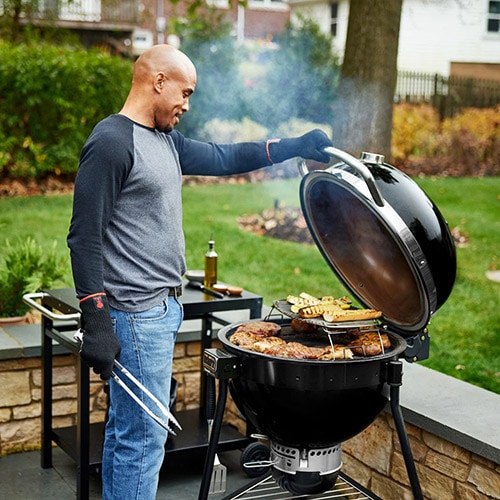
We love the versatility of charcoal kamados, but they’re called “grills” for a reason. Using a kamado without a deflector plate is identical to using a basic charcoal grill, and the resulting direct, radiant heat is more than enough to put steakhouse-level sear marks on a thick sirloin. Because grilling uses radiant heat from the charcoal below rather than the ceramic walls, there’s no need to preheat the entire unit when grilling. That’s why all you need is about 5 minutes to get your cooking grates roaring hot, whereas preheating an entire kamado to 200–250 degrees for smoking can take anywhere between 30 and 45 minutes. Just place a temperature probe at the center of the cooking grates to let you know when they’re hot enough to grill and sear.
A Note on Preheating Your Kamado: Be careful not to overdo your preheat when getting a kamado cooker ready for smoking or baking. It’s easy to heat up ceramic, but because it retains heat so well, bringing the temperature back down is much more difficult. You should preheat your kamado charcoal grill for about 30–45 minutes, until the ceramic reaches the temperature you want and no more. At that point, all you have to do is load your kamado with amazing meats, close the lid, and set your vents to the appropriate temperature settings.
Top Kamado Grill Brands



Advantages of Kamado Grills

Heat Retention
Ceramic provides such strong insulation that almost all of a kamado’s heat is captured and used to cook your food before exiting the grill.

Even, Steady Heat
Because ceramic is a poor conductor of heat and radiates it very slowly, temperatures will remain stable throughout the grill’s cooking chamber.

Fuel Efficiency
The ceramic walls of kamado grills take a long time to transfer heat, meaning they consume less fuel than normal charcoal grills or smokers.

Versatile Cooking
Kamados are capable of grilling, baking, smoking, roasting, searing, and barbecuing, and certain accessories make each cooking style easier.

Less Moisture Loss
When smoking meat, kamado vent settings permit very little drafting within the grill, so your food is exposed to less dry, moisture-robbing air.

Long-Lasting
Though ceramic is quite fragile, it can last generations when properly taken care of. Cast aluminum kamados, meanwhile, will never rust.

Easy to Clean
Just get the grill roaring hot to burn everything off, then clean out the ashes. Ceramic absorbs liquid, so never use liquid cleaners on a kamado.

Incredible Flavor
The nasty taste of lighter fluid will absorb into ceramic forever, so kamados give you no choice but to enjoy classic charcoal BBQ flavors.
Other Kamado Grill Considerations
If you’ve already got a kamado charcoal cooker in mind, congrats! We’re thrilled to have helped you on this journey, but we wouldn’t be doing our due diligence if we didn’t leave you with a few final considerations about kamado grills. These grills provide a truly one-of-a-kind cooking experience for decades when properly supported and maintained, so we want to make sure you’ve given thought to every single factor that can influence the longevity and capabilities of your kamado.
Kamado Accessories
The number of accessories available varies greatly and is dependent on the manufacturer. This is important to keep in mind because accessories have a huge influence on the versatility of kamado charcoal grills. Dividers and heat deflector plates, for instance, open up new worlds of indirect cooking for the griller who loves to try new things.
When considering accessories, don’t just think about what you cook now — plan for the future and any cooking experiments you might want to try. Make sure the kamado you plan on purchasing has the accessories you want, either included or available after purchase. For more suggestions, check out our guide to the essential kamado grill accessories.
Hood-Lift Assist for Kamados
Remember our discussion about ceramics? It’s a super heavy material despite its fragility, which means shutting the grill lid should be done with the utmost care. A slammed lid is at a risk of cracking part of the grill body, which is why we recommend ceramic kamados with some sort of lift-assist function to lighten the load each time you close the grill lid. Not only will your kamado cooker be easier to use, but it will also last longer than one not properly cared for.
Kamado Chimneys
Because the exhaust vent (or chimney) at the top of your kamado is often directly exposed to the elements when cooking, we advise you to look for a grill with sturdy fittings and a chimney that won’t rust. Tight vent settings are also important — who wants to lift the lid, adjust the coals and food, then close the lid, only to find their vent settings have changed? It’s also a good idea to make sure the chimney is water-resistant in the event your grill is left out in the rain … or you could just get a grill cover and never worry about rain at all!
Kamado Vent Hoods
There are several safety considerations that come with built-in charcoal kamados, but your outdoor kitchen vent hood will also come into play. Many vent hood manufacturers don’t allow any kind of charcoal grill to be placed below their vents because these cookers lack a definable maximum heat setting. If you want to build in a kamado grill, you must be certain your vent hood brand permits this or you could void the warranty on your hood. You’ve been warned, first-time builders.
Big Green Egg Kamados
We know what many of you are thinking right now: I just feasted my eyes on several gorgeous images and hundreds of brilliantly crafted words about kamado grills, but I didn’t see a single Big Green Egg anywhere!
Unfortunately, Big Green Egg doesn’t allow online sales of its grills. Though Big Green Egg is undoubtedly the most popular name in the charcoal kamado industry, we’re proud to carry dozens of models that give it a run for its money.
Ready to chat with one of our BBQ experts about the kamado grill you want? Or do you need more guidance on the subject? Either way, our experts are standing by at 1-877-743-2269 to answer any questions you have about kamados. We also encourage you to visit our Free Outdoor Living Design Service, which has helped thousands of customers across the country create their dream outdoor space.

