
)
How to Arrange Patio Furniture for Conversation and Entertaining
You've done everything right. Nice furniture, good weather, plenty of space. So why does everyone end up clustered near the back door or crowded around the one table, drinks in hand, not quite settling in? The conversation never really gets going. The problem isn't the patio or the people. It's the arrangement.
The good news is that knowing how to arrange patio furniture is a skill, not a talent. You don't need a design background or a bigger backyard. A few intentional decisions—the right anchor, the right grouping, the right scale—can turn the same space into one people genuinely don't want to leave. Let's walk through how to get there.
Key Takeaways
- Layout makes or breaks the space. The right arrangement creates natural gathering zones; the wrong one creates awkward silence and traffic jams.
- Design for conversation. Keep facing seats 6–10 feet apart—close enough to talk without yelling.
- Build around an anchor. A fire pit table, dining table, or kitchen island grounds the arrangement; let the seating follow from it.
- Scale up outdoors. Pieces that look right in a showroom read small and scattered outside. Favor larger furniture and tighter groupings.
- Make it flexible. Lightweight chairs, ottomans, and moveable side tables shift the space from a dinner for 4 to a party of 20 without a full reset.
Every Great Layout Starts With the Anchor
Most people arrange patio furniture the same way they arrange a living room. Everything gets pushed to the edges, lined up against the perimeter, leaving the center open. It looks tidy but kills conversation.
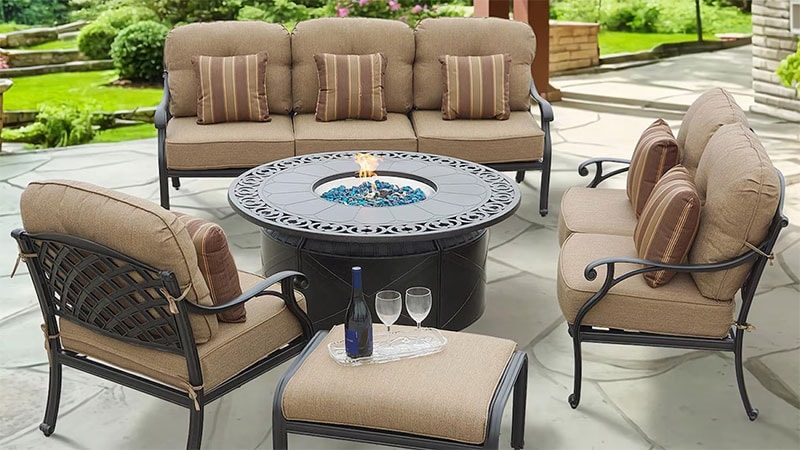
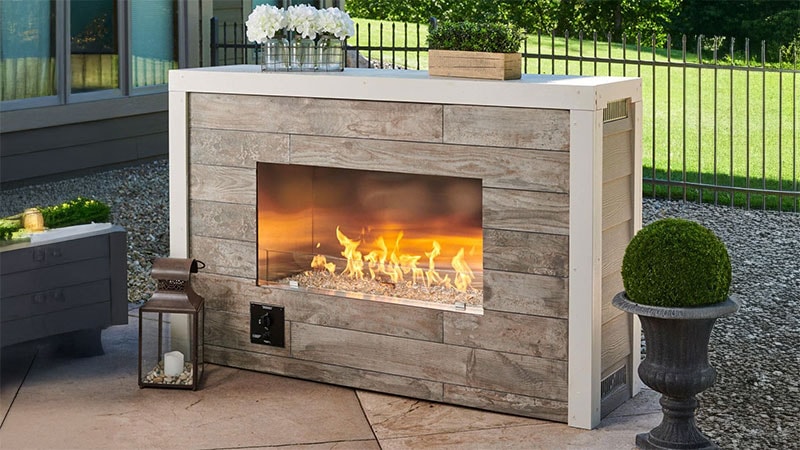
Every well-arranged outdoor space has an anchor. It's the central object your seating faces and gathers around, the focal point that gives the whole layout a reason to exist. In an outdoor space, that anchor is usually a fire pit table, a dining table, an outdoor kitchen island, a fireplace, or a statement piece like a large planter. The specific object matters less than what it does. It gives every seat a direction to face and a reason to pull in close.
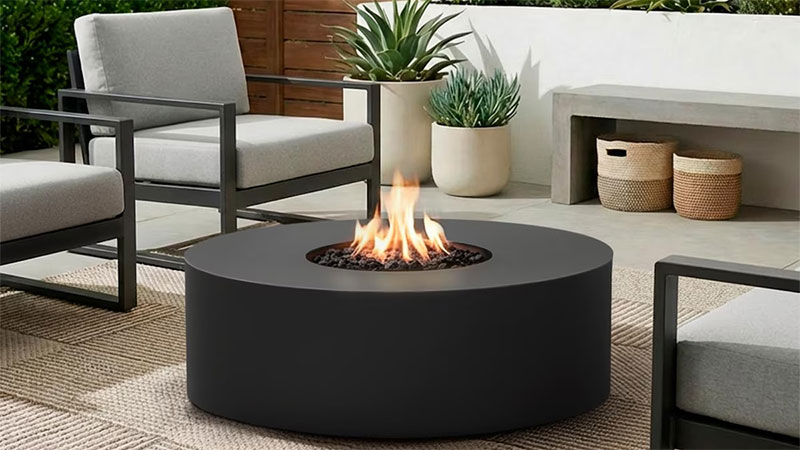
If your patio doesn't have a natural anchor yet, a fire pit table is the easiest and most versatile place to start. It provides warmth, ambiance, and a functional surface for drinks and plates, all in one piece. Place it at the center of your space, pull the seating in around it, and the rest of the layout takes care of itself.
Zone Your Patio for Multiple Uses
Most patios pull double or triple duty, serving as a space for casual lounging, dinner parties, grilling, and kids' play. One furniture arrangement can't handle all of it well. The solution is zoning and deliberately dividing your patio into functional areas, each with its own furniture grouping and purpose.
Most patios benefit from the following zones:
- Conversation/lounge zone: Deep-seat chairs or a sectional grouped around a fire pit table or coffee table, built for lingering. This is your anchor zone, and everything else arranges around it.
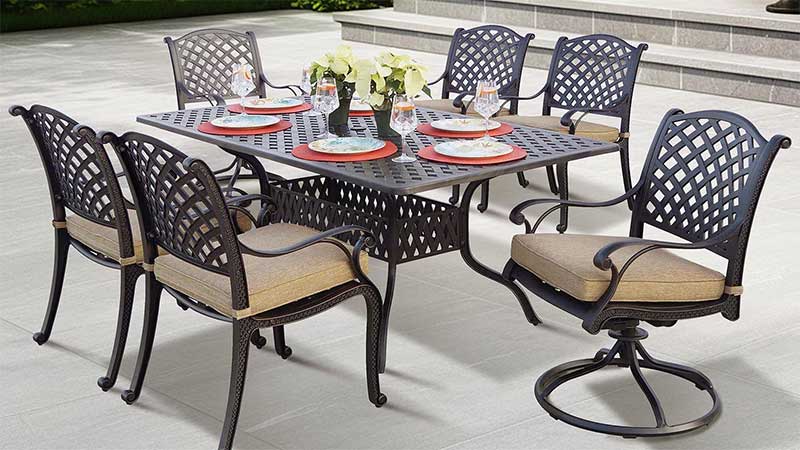
- Dining zone: A table and chairs sized for your typical headcount, positioned apart from the lounge area. Plan for at least 3 feet of clearance on all sides of the table so guests can pull chairs back without bumping into anything.
- Cooking/grilling zone: The grill or outdoor kitchen as its own defined station, not an afterthought tucked in the corner. Keeping it separate protects your guests from heat and smoke and gives the cook room to actually work.
You don't need walls to separate these areas, just visual definition. Different flooring textures work well, with pavers for the lounge area, decking for dining, and gravel under the grill. An outdoor rug grounds a conversation grouping instantly. Planters make natural dividers without blocking sightlines. Even the gap between furniture clusters signals a zone boundary.
As you measure, keep in mind that a lounge zone needs at least 10 to 12 feet across to feel comfortable with 4 to 6 seats, while a dining zone needs roughly 3 feet of clearance on all sides for chair pullout.
Get the Spacing Right for Conversation
Numbers matter here. The sweet spot for comfortable conversation seating is 6–10 feet between facing seats. Less than 6 feet and people start to feel like they're sharing an elevator. More than 10 feet and guests have to raise their voices, which ruins the easy, stay-a-while feeling you're after.
A few measurements worth keeping in mind:
- Seat-to-seat across your anchor: 6–8 feet works well for a group of 4–6. Tight enough to talk, comfortable enough to relax.
- Clearance around a dining table: at least 36 inches on all sides so chairs can pull out without bumping anything. Budget 42–48 inches if you're hosting dinner parties where people are moving in and out of their seats.
- Pathway clearance: 36 inches minimum for a casual walkway through the space; bump that to 48 inches on any path that doubles as a main traffic route.
- Side table height: level with or just below chair arm height. Guests shouldn't have to lean to set down a drink.
The most common outdoor spacing mistake? Too much distance between seats. An open backyard feels big, and people instinctively move furniture toward the edges. Don't. Pull things in. Closer groupings are what actually make conversation happen.
Choose Seating That Supports the Layout
A well-planned arrangement only works if the furniture can hold it. Before you buy—or before you rearrange what you already have—it helps to know what each seating type actually does well outdoors.
Outdoor Sectionals
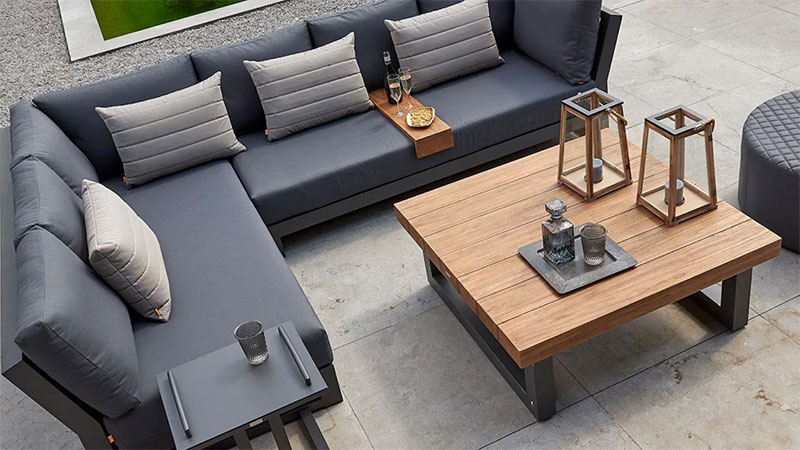
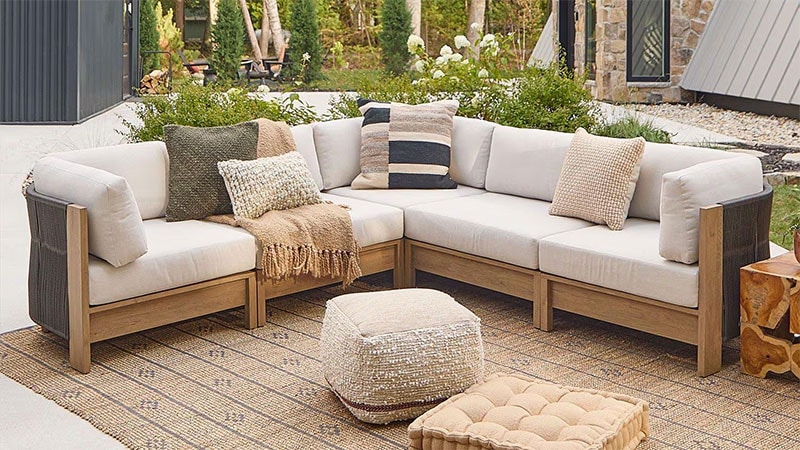
Sectionals are the highest-capacity option for a given footprint. An L-shape or U-shape creates a natural enclosure around a fire pit table or anchor piece, which makes the conversation zone feel intentional rather than improvised. The tradeoff? Sectionals limit flexibility, so they work best in a patio with a clearly defined lounge zone.
Conversation Sets
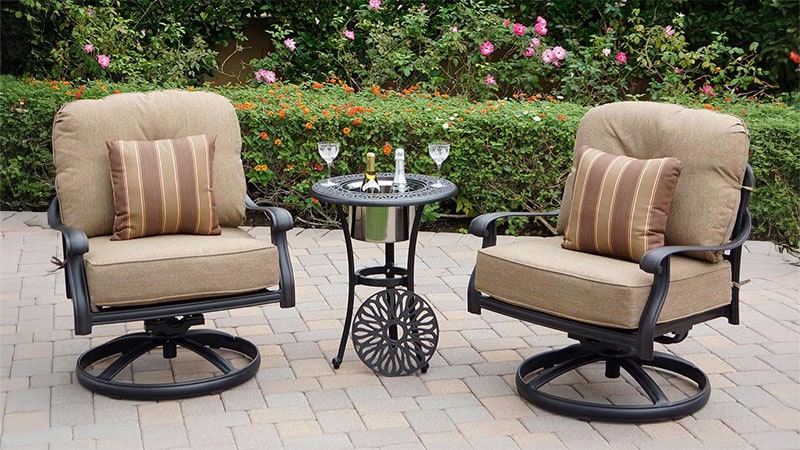
Conversation sets are the workhorse of most arrangements. They're easy to reposition, work just as well in a pair as they do in a group of 4–6, and they're genuinely comfortable—the kind of seating that makes people stay another hour. A set of 4 matching deep-seat chairs handles the majority of outdoor entertaining situations.
Ottomans
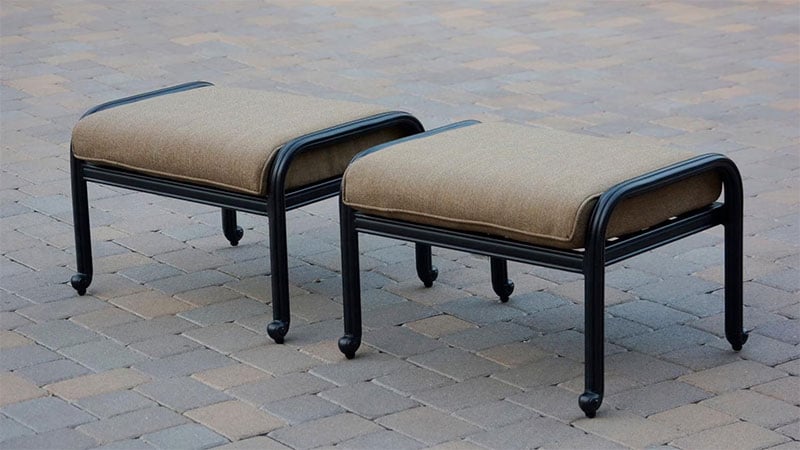
Ottomans are underused on most patios. They pull extra seating duty when you need it, serve as footrests when you don't, and can hold a tray when a side table isn't within reach.
End Tables
End tables are the quiet heroes of any conversation grouping. Aim for 1 table for every 2 seats to keep guests from holding their drinks all night and eliminate the surface scramble that breaks up good conversation.
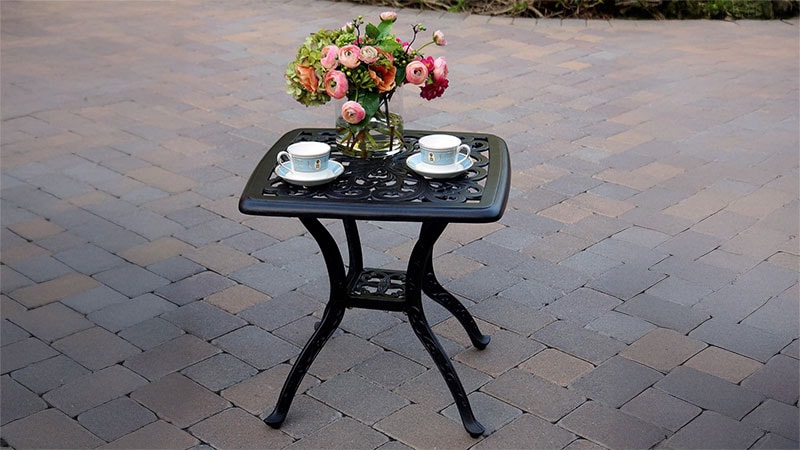
Small Patio? Arrange for Intimacy, Not Capacity
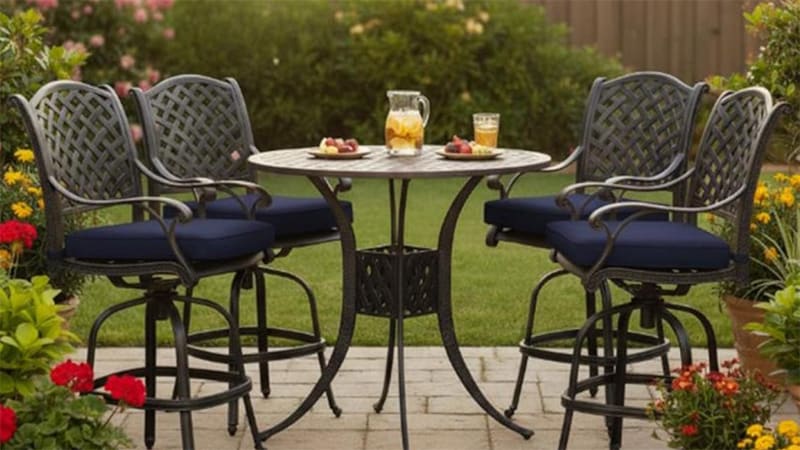
A compact patio isn't a design problem. Instead, it's a design constraint, and constraints call for a little creativity. The goal isn't to squeeze in as many seats as possible; it's to create a space that feels intentional for 2–4 people. A well-arranged small patio for 4 feels infinitely better than an overcrowded one straining to seat 8.
Start with a bistro set or small round table as your anchor. Round tables earn their keep in tight spaces—no corners to navigate, and every seat gets equal sightlines. From there, let visual lightness do the work. Thin metal frames, sling chairs, and glass-top tables keep the space feeling open rather than cluttered.
Go vertical wherever you can. Wall-mounted planters, a compact vertical herb garden, or a wall-mounted string light anchor add warmth and life without eating into your floor space.
Skip the sectional. In a small space, a large sectional dominates the layout and eliminates your ability to rearrange for different uses. Instead, keep a foldable or stackable chair or 2 stashed nearby. They expand your seating for the occasional larger gathering without permanently living on the patio. Small patios reward curation. Work with the space you have, and it'll work for you.
The Finishing Touches That Pull a Layout Together
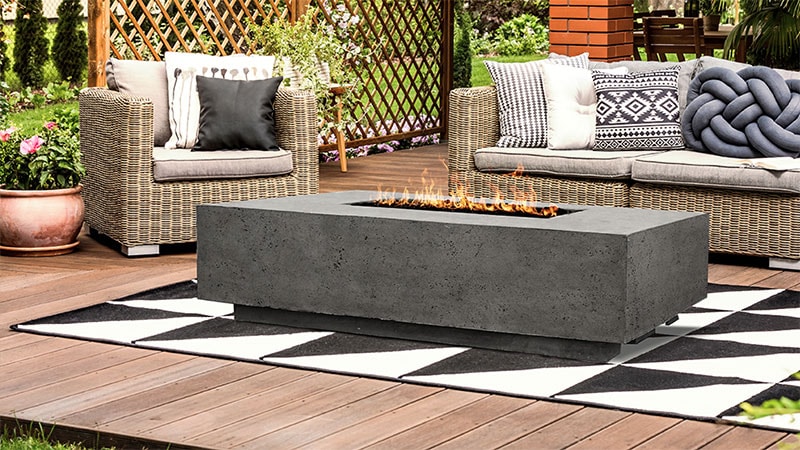
The furniture is in place. Now make it feel like somewhere people actually want to sit down. A few well-chosen details are what separates a thought-out outdoor space from a showroom floor.
Start with an outdoor rug. It's the single most impactful finishing touch in any lounge zone, defining the seating area, adding warmth underfoot, and giving the whole grouping a sense of place. Size matters here: the rug needs to be large enough that the front legs of every seating piece rest on it. A too-small rug tucked only under the coffee table visually breaks the zone apart. For a standard lounge grouping, start with an 8-by-10-foot rug.
Throw pillows and cushion color are the fastest way to give a neutral furniture set personality. Look for outdoor fabrics made with solution-dyed acrylic, which resists fading and mildew through seasons of sun and rain. Mix 2–3 complementary colors or patterns in varying sizes for depth without chaos.
Potted plants and planters define zone edges without building walls. A pair of tall planters flanking a seating area creates a sense of enclosure while keeping sightlines open.
Finally, don't let the arrangement go dark at sunset. String lights overhead or a floor lamp beside a lounge chair extend the hours your patio gets used. For a deeper look at lighting an outdoor space year-round, see our guide to designing a four-season outdoor space.
The best backyard isn't the biggest one. It's the one where nobody's checking their phone and everyone stays later than they planned. You now have the layout principles to build that space. All that's left is putting them to work.

